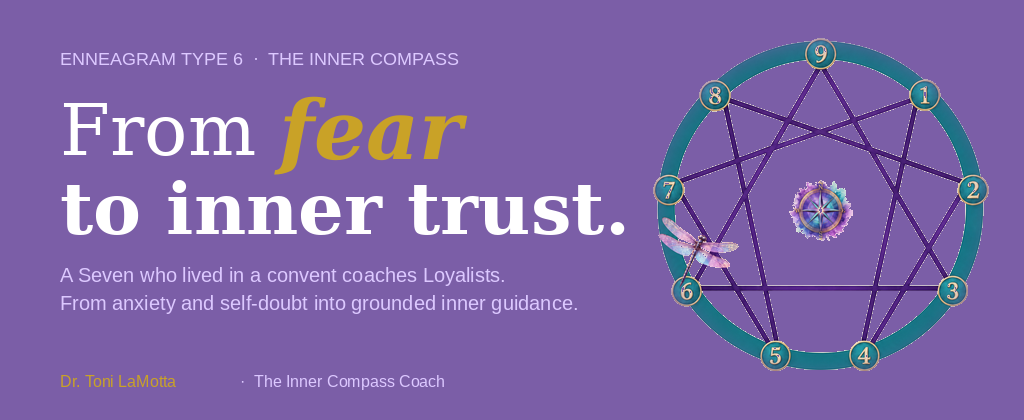
 Enneagram Type 6 Coach: From Anxiety to Inner Trust
If you’re an Enneagram Type 6, you know what it’s like to live with chronic self-doubt, overthinking, and the exhausting search for certainty. I’m Dr. Toni LaMotta — an IEA-accredited Enneagram coach and Type 7 who spent 16 years under a vow of obedience. I know fear from the inside. And I know the path out.
Ready to go deeper with your Enneagram Type 6 pattern?
Join me live every Tuesday at 11am ET for Uncover the Enneagram — a live online class where we explore how your type shapes everything from your relationships to your deepest fears. Type 6 is where we begin.
If you are an Enneagram Type 6, this is your inner compass pathway into self-trust.
Enneagram Type 6 is the journey of developing inner trust through fear, doubt, and the search for certainty. This is the inner compass path—where anxiety becomes the doorway to grounded guidance, clarity, and self-trust.
This is not neurosis. It is not weakness. It is a deeply ingrained orientation toward the world that almost always grew from a real place: an early environment that required vigilance to navigate, a childhood that made watchfulness feel like survival. Your threat-detection system didn’t malfunction. It learned.
The problem is that what kept you safe then is running your life now.
What Enneagram Type 6 Actually Looks Like
Type 6 — called the Loyalist or the Loyal Skeptic — is one of the most complex and misunderstood types on the Enneagram. Sixes belong to the head center, which means the primary strategy for navigating life is mental. But unlike Fives, who gather information for mastery, or Sevens, who gather options for freedom, Sixes gather information to manage threat. The magnificent, overclocked Six brain is, at its core, a threat-detection system.
This shows up differently depending on the Six. Some Sixes are openly anxious — they defer to authority, seek reassurance, and work hard to stay affiliated and safe. Others are counter-phobic — they charge toward what frightens them, challenge authority, and take risks, not because they are fearless, but because moving toward danger feels more controllable than waiting for it. Most Sixes are a blend of both, shifting depending on the situation.
What all Sixes share is this: the basic proposition that I will be okay if I can find something trustworthy to believe in and remain loyal to it. The tragedy — and the gift — is that Sixes are constitutionally unable to find that something outside themselves, no matter how hard they look. Not because trustworthy things don’t exist, but because the authority they are ultimately seeking is their own Inner Compass, and they have been directed everywhere else.
The Gift Hidden in the Fear
Every type on the Enneagram carries a wound that is also a gift. For the Six, the wound is fear. The gift is courage.
Not the courage of someone who doesn’t feel fear. The courage of someone who feels it completely and moves forward anyway. That is one of the most spiritually significant forms of courage there is.
Sixes are constitutionally oriented toward inquiry — they cannot leave the hard question alone, cannot make peace with easy answers, cannot settle for the first authority that offers certainty without testing it. That is not a defect. That is discernment waiting to be claimed. The Six’s doubt is not the enemy of faith. It is the birthplace of it.
When a Six accesses their virtue — courage — they become luminous. They are the ones who speak truth in rooms where no one else will. Who question the consensus when the consensus is wrong. Who hold loyalty not as blind deference, but as something they have wrestled with and freely chosen.
Why a Seven Coaches Sixes — and Why It Works
People often raise an eyebrow when they discover my work. A Seven coaching Sixes? It seems, on the surface, like an unlikely pairing. Sevens run toward joy; Sixes run from danger. Sevens trust life; Sixes interrogate it.
And yet I have spent years sitting across from one of the most beautifully complex types on the Enneagram, and I keep coming back. Because I believe the bridge between a Seven and a Six is not built on similarity. It is built on the fact that we are looking for the same thing.
I am an Enneagram Seven. I am also a former nun. I spent sixteen years inside one of the most rule-governed, loyalty-demanding institutions the human world has built — not because I was forced, but because some part of me believed the container would keep me safe. I know what it is to trust structure more than yourself. I know what it costs. And I know what it looks like when the structure breaks and you discover, in the wilderness it leaves behind, that you had been carrying the ground with you all along.
That knowledge is not theory. It is testimony. And it is what I bring to my work with Sixes.
When a Seven has done their own interior work — when they have stopped running from the depth and turned to face it — they become uniquely equipped to companion Sixes. Not because they share the Six’s fear, but because they have been to the bottom of their own. They just went down from a different angle.
What the Work Is
This hub is a place to begin to understand your Type 6 pattern — and more importantly, how to move beyond it. The goal is not the elimination of fear. It is learning to change your relationship to it. Not more thinking, more preparing, more analyzing. But noticing. Softening. Trusting what is already within you.
The inner compass was never broken. It was buried — under years of other people’s voices, other people’s certainties, other people’s fear dressed up as wisdom. The work is excavation.
You don’t have to read everything below. You just need to begin where you actually are..
If you’re new to understanding your Enneagram Type 6 patterns, begin with these:
- Why Are Enneagram 6s So Anxious?
- When the Mind Won’t Stop Spinning
- Why Enneagram 6s Struggle to Trust Themselves
Anxiety & the Enneagram 6 Mind
- The Loyalist: Understanding Enneagram Type 6
- The Enneagram 6 Trust Paradox
- Enneagram 6 and the Need for Reassurance: Why It Never Feels Like Enough
- When Trust Feels Dangerous: The Hidden Fear Behind Enneagram 6
- You Don’t Trust Yourself — And It’s Not an Accident
- Mind Won’t Stop Scanning for Danger: The Hidden Gift of Enneagram 6
- Enneagram 6 and the Authority Question: Who Do You Trust?
- When the Mind Becomes a Maze
- Enneagram 6 and the Exhaustion of “What If”: How to Step Out of the Anxiety Loop
- Enneagram 6 & The Exhaustion of Always Preparing
- Enneagram 6 and the Exhaustion of Hyper-Responsibility
- When Safety Becomes a Cage: The Hidden Cost for Enneagram 6
- Type 6 and “It Depends”.
- Enneagram 6 and Calming the Nervous System
- How to Calm Anxiety as an Enneagram Type 6
- After You Calm the Nervous System… What Comes Next?
The Growth Path of Enneagram 6
- The Virtue of Courage for Enneagram 6
- The Hidden Strength of Enneagram Six: Courage
- Enneagram 6 and the Courage to Trust Yourself
- When Doubt Gets Loud: Reclaiming Inner Authority as an Enneagram 6
- Enneagram 6 and Decision-Making Without Reassurance
- Enneagram 6 and the Fear of Getting It Wrong: How to Trust Yourself Again
- Fear vs Intuition for Enneagram Type 6: How to Tell the Difference
- The Enneagram 6 and the Return to the Inner Compass
- The Type 6 Inner Compass: Learning to Trust Your Gut
- The Moment Before Doubt: Reclaiming Trust from the Inside Out
- The Hidden Loyalty Behind a Six’s Resistance to Growth
- When Loyalty Becomes Self-Abandonment: An Enneagram 6 Turning Point
- The Moment Trust Becomes Real (Not Just a Concept)
The Spiritual Path of Enneagram 6
- When Safety Isn’t the Answer: A Spiritual Insight for Enneagram 6
- Trust Beyond Certainty: A Spiritual Insight for Enneagram 6s
- Moving from Fear to Faith: The Spiritual Path of Enneagram 6
- The Holy Idea of Faith in the Enneagram
Enneagram 6 in Relationships
-
- Enneagram 6 and 8: The Power Struggle No One Names
- Enneagram 6 and 9 Relationship: How Type 6 Learns Trust Through Presence
- When the Loyal Skeptic 6 Meets the Enthusiastic Visionary 7
- Enneagram 6 and Enneagram 2: Loyalty, Love, and the Hidden Dance Between Fear and Care
- Enneagram 6 and 4 Relationship: Why They Clash and How to Make It Work
- Enneagram 6 and 1 Relationship Compatibility: Trust, Conflict, and Growth
- Enneagram 6 and Enneagram 3 in Relationship: Loyalty Meets Ambition
- Enneagram 6 and 5 Relationship: When the Loyal Skeptic Meets the Quiet Observer
Wings
Arrows
Practices
5 Practices to Help Enneagram Type 6 Build Self-Trust and Activate Your Inner Compass
A Gentle Invitation
If you’re an Enneagram 6—or love someone who is—the journey is not about eliminating fear but discovering the deeper courage already within you.
My work helps people reconnect with their Inner Compass, the deeper wisdom that emerges when we stop letting fear lead the way.
If you are really ready to go deeper, join me for a 6-month hybrid coaching and training program. Begin to explore my complete work on the Inner Compass System here.
Dr. Toni LaMotta is The Inner Compass Coach, specializing in spiritual growth and transformation for Enneagram Type 6 personalities through shadow work, conscious living, and the Spiritual Enneagram.